

Custom Arc Fault Detection Devices: Tailored Protection for Complex Electrical Systems
2026-08-24
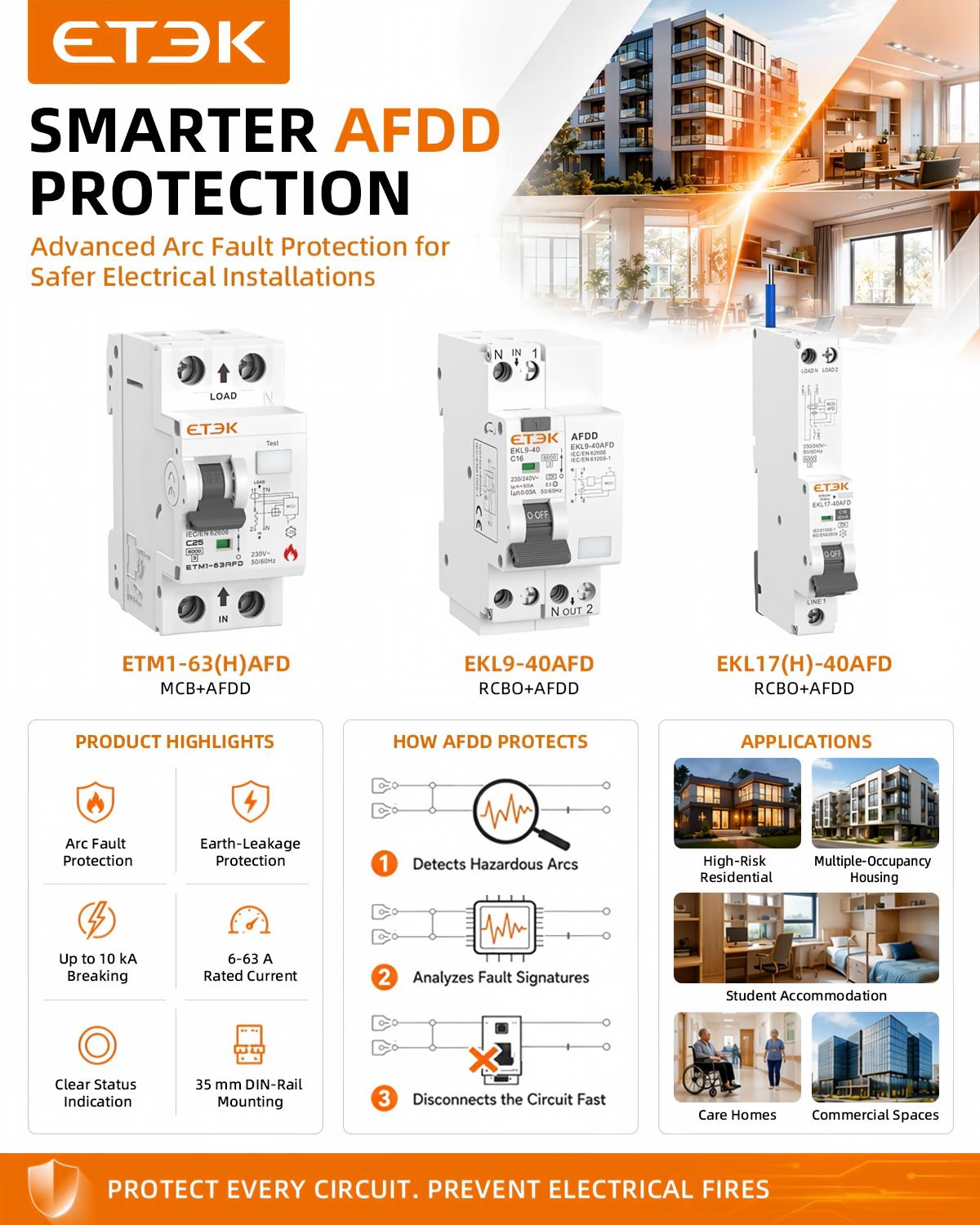
Electrical systems in complex facilities rarely behave like textbook diagrams. Standard arc fault detectors, built for generic conditions, can leave dangerous blind spots when real-world loads, harmonics, and ambient noise come into play. That’s why ETEK focuses on custom engineered protection—devices tuned to the exact fingerprint of your installation. In this article, we’ll unpack how tailored arc fault detection closes the gaps that off-the-shelf units miss, and why that difference matters more than most engineers expect.
The Problem with Generic AFDDs in Complex Electrical Networks
Generic arc fault detection devices tend to rely on a fixed set of thresholds and filtering algorithms that were tuned for relatively simple, single-load residential circuits. Once you move into larger commercial or industrial electrical networks with multiple nonlinear loads, variable frequency drives, and extensive cable runs, those assumptions break down. The result is a device that either fails to catch dangerous arc signatures because they are buried under harmonic noise, or trips unnecessarily when normal switching transients occur. Neither outcome is acceptable when downtime costs money and missed faults cost lives.
Another issue is the lack of context awareness. Standard AFDDs treat every circuit branch the same way, even though a feeder serving a motor control center behaves very differently from a branch circuit feeding LED lighting. That means the same arc signature can be interpreted as a fault on one circuit and as normal operation on another. Without the ability to adapt to the network topology and load profile, these devices introduce a false sense of security. Electricians end up disabling them out of frustration, which defeats the whole purpose of the protection.
Finally, the interaction between multiple AFDDs on the same network is rarely considered in generic designs. When several devices sit on adjacent breakers, they can interfere with each other's sensing circuits, especially through shared neutral paths or ground loops. One AFDD may detect an arc event and send a high frequency signal that another device misreads as a fault in its own zone. Sorting out these cross-talk issues in the field often requires guesswork and replacement of perfectly good units, because the generic algorithms were never built to handle cooperative detection in a dense electrical environment.
Reading Your System's Electrical Fingerprint Before Building Protection
Every electrical network hums with a unique signature, shaped by the loads it carries, the age of its wiring, and the quirks of its connected equipment. Before adding surge arresters or isolation transformers, it pays to map this underlying behavior. Current harmonics, transient ringing, and baseline impedance all leave traces you can measure with a portable power analyzer. Rather than assuming a generic threat model, capture actual switching events and inrush patterns over several days. That recorded fingerprint tells you where the system is already stressed and which protection topology will truly fit.
A common mistake is to treat protection design as a one-size-fits-all bolt-on. Instead, compare the captured waveform data against the limits of your sensitive loads. Look for recurring voltage sags during motor starts, high-frequency noise from variable frequency drives, or neutral-ground voltage shifts that point to poor bonding. These are not abstract risks; they are visible in the harmonic spectrum and time-domain plots. By quantifying them first, you avoid over-specifying surge ratings or installing filters that fight problems you do not have.
Once the baseline is clear, protection choices become almost mechanical. A site dominated by capacitor-switching transients calls for different mitigation than one plagued by lightning-induced common-mode currents. The electrical fingerprint also serves as a before-and-after reference, letting you verify that each added device actually reduces stress at the point of use. Skipping this step often leads to layered protection that still leaves a single vulnerable node exposed, simply because no one looked at the patterns already present in the conductors.
Arc Fault Signatures That Only Custom Logic Can Catch
Most arc fault detectors trip on the obvious stuff: tall current spikes, wideband noise bursts, or a sudden loss of zero-crossing symmetry. But in real installations, the earliest and most dangerous arcs often hide inside normal load behavior. A loose screw terminal on a lighting circuit can generate tiny shoulders just before voltage zero crossings—sometimes only 2 to 4 microseconds wide—barely above the noise floor of a switching power supply. Generic algorithms either ignore these as nuisance or average them away over several AC cycles.
Custom logic changes the calculus because it can watch for phase-locked irregularities that never repeat cleanly. For example, a series arc on a dimmer-controlled LED branch may shift the current rise time differently on positive half-cycles than on negative ones, while a standard RMS threshold sees nothing unusual. By tracking re-strike intervals, pre-zero di/dt variance, and pulse asymmetry against a learned baseline for that specific circuit, the logic flags the pattern without waiting for a full short-circuit event. It is not a louder alarm—it is a better set of eyes.
Making Custom AFDDs Play Nice with Legacy Panels and PLCs
A lot of the friction comes from the physical layer. Custom AFDDs built for modern DIN-rail setups often assume spare slots, clean 24V DC supplies, and a dedicated communication bus. Drop one into an older panel and you are usually looking at crowded terminals, mixed AC/DC control voltage, and no free real estate for a gateway. One practical fix is to use the AFDD's relay output as a dry contact wired into an existing alarm input on the panel. Add a small interposing relay if the contact rating is too low, and power the AFDD from a fused tap off the control transformer rather than trying to pull from a PLC's limited sensor supply.
For PLCs, the mismatch is often about signal levels and timing. A custom AFDD might toggle a solid-state output faster than a legacy PLC input can reliably catch, or it may send a Modbus frame that an older serial card chokes on. The simplest path is usually to slow things down. Configure the AFDD's output pulse width to at least twice the PLC's scan time, and if you must use serial, put a small protocol converter between the AFDD and the PLC. Watch the ground reference too. Many nuisance trips in retrofits come from floating grounds between the AFDD's electronics and the PLC chassis. A single-point bonding jumper usually clears that up.
Once the wiring and electrical compatibility are sorted, the last hurdle is logic. Legacy PLC programs are rarely structured to handle a new fault input cleanly. Instead of rewriting the whole routine, insert a latching rung that captures the AFDD trip and feeds a dedicated alarm bit. Keep the reset separate from the E-stop or general fault reset so maintenance can distinguish an arc fault from an overload. Test the whole chain with a simulated trip before relying on it, and document which register or bit maps to which terminal. That way the old panel gets the new protection without the commissioning nightmare.
Where Custom Arc Fault Detection Earns Its Keep: Real Installations
Arc fault circuit interrupters often get dismissed as an unnecessary add-on until a real-world scenario proves otherwise. In older homes where wiring has been patched, extended, or chewed by rodents, the insulation breaks down slowly. A standard breaker sees the resulting current as a normal load, never tripping. An AFCI, however, recognizes the chaotic signature of an arc and cuts power in milliseconds. That distinction has kept more than one attic from becoming a chimney.
Commercial kitchens are another place where AFCI technology quietly earns its keep. Grease, heat, and constant vibration loosen connections inside walls and behind equipment. A loose terminal screw may carry current fine for months, but the microscopic gap becomes a spark generator under heavy load. Traditional overcurrent protection never notices, because the current draw stays within the breaker's rating. Arc fault detection catches the intermittent sputter before it finds a combustible surface.
Outdoor installations face a different kind of abuse. UV exposure, moisture, and temperature swings degrade wiring at junction boxes and light fixtures. A corroded splice can arc for weeks without tripping a standard breaker. Installers who add AFCI protection to exterior circuits often see trips that seem like nuisance events at first—but closer inspection reveals a wiring fault that would have eventually ignited. In these real installations, the technology isn't a regulatory checkbox; it's the difference between a service call and a fire report.
Adaptive Protection That Evolves with Your Electrical Load Profile
Traditional protection schemes rely on fixed thresholds that assume a static electrical environment. But real-world loads shift constantly—motors start, HVAC systems cycle, and new equipment gets installed. Instead of locking you into outdated assumptions, adaptive protection continuously observes your actual load profile and re-tunes its trip characteristics to match what’s really happening on the circuit. This means the protection boundary moves with you, not against you.
The result is a system that catches subtle fault signatures that fixed settings would miss, while ignoring harmless inrush currents that often trigger nuisance trips. Over time, the algorithm builds a living model of your facility’s electrical behavior, so it can distinguish between a genuine fault and a temporary, safe operating condition. You get fewer false alarms and faster response when it actually matters.
Because the protection adapts automatically, you also avoid the costly engineering study required to update settings after every change to your electrical system. Whether you add a new production line or shift load between feeders, the protection follows your profile without manual recalibration. That keeps your system safe, compliant, and ready for whatever you plug in next.
FAQ
A custom unit is engineered around the specific load profile and wiring layout of your installation. Instead of using generic trip curves, it accounts for unusual harmonics, high inrush currents, or mixed AC/DC circuits, so nuisance tripping drops while genuine arc faults are still caught early.
They use multiple detection algorithms or adjustable frequency bands to distinguish between normal operational signatures and dangerous arcs. For example, a motor start might produce a short high-frequency burst that would confuse a standard AFDD, but a tailored device can be programmed to ignore that pattern while remaining alert to sustained arc signatures.
Yes, that is one of the main reasons to go custom. You can set different thresholds per branch circuit, delay tripping slightly for equipment with large inrush currents, or make the device ultra-sensitive for circuits feeding critical life-safety or data-center loads.
Industrial plants with variable frequency drives, hospitals with isolated power systems, data centers with high-density server racks, marine vessels, and research labs with non-standard power electronics often need tailored protection because their electrical signatures fall outside the assumptions baked into residential or commercial AFDDs.
Most custom devices support common industrial protocols like Modbus, BACnet, or Ethernet/IP, and can output detailed fault logs, real-time current signatures, and self-test results. That allows facility teams to see exactly which circuit tripped and why, rather than just getting a binary alarm.
They should map out the full range of normal operating currents, harmonic content, environmental conditions like temperature and vibration, and any relevant code requirements. Sharing actual waveform captures with the manufacturer helps to tune detection algorithms so the device does not either false trip or miss a slow-developing arc.
The basic test button function remains, but custom units often include remote self-diagnostics, event memory, and firmware update capabilities. Some can simulate arc signatures through software, allowing periodic verification without exposing the circuit to a real fault. Maintenance staff should receive training on reading the device logs to spot early insulation breakdown before it becomes a full arc.
Reputable manufacturers design custom units to comply with IEC 62606, UL 1699, or equivalent regional standards, and may have the device third-party tested for the intended application. Always request documentation showing the specific deviations and how they were validated for your system's voltage and current ratings.
Conclusion
Generic arc fault detection devices often struggle inside complex electrical networks because they rely on fixed thresholds and assumptions that do not match the way industrial or mixed-load systems actually behave. Nuisance tripping and missed faults are common when the protection is not built around the specific electrical fingerprint of a facility. A more effective approach starts with mapping voltage and current signatures across normal operating conditions before any protection logic is finalized. This allows the detection scheme to separate harmless noise, motor inrush, and switching transients from true arc signatures. Custom logic can then target arc fault patterns that off-the-shelf units overlook, such as intermittent series arcs behind heavily filtered drives or parallel arcs masked by nonlinear loads. Just as important is the ability to integrate with legacy panels and PLCs without forcing a costly control system overhaul. Custom AFDDs can communicate through existing dry contacts, analog outputs, or serial protocols, preserving the plant's original architecture while adding a layer of protection that was never designed into the older equipment.
Real installations show where this tailored approach earns its keep. In older manufacturing lines, commercial kitchens, and remote pumping stations, standard AFDDs frequently trip on normal operations or fail to detect dangerous arcing because the load profile is far from residential. Custom arc fault detection solves this by adapting to the way each load behaves over time. As motors age, production schedules shift, or new equipment is added, the protection can be recalibrated or can self-adjust within safe boundaries rather than requiring replacement. This adaptive protection evolves with the electrical load profile, reducing downtime and avoiding the false sense of security that comes from a one-size-fits-all device. By combining site-specific fingerprinting, custom arc signature recognition, and compatibility with legacy infrastructure, these tailored devices deliver protection that fits the actual electrical system instead of forcing the system to fit the device.
Contact Us
Contact Person: Andy
Email: [email protected]
Tel/WhatsApp: +86 13356133008
Website: https://www.etek-china.com/