

Gantry Barrel Zinc Plating Equipment Factory Delivers Precision Plating Solutions
2026-09-04
Most zinc plating lines promise repeatability; delivering it across thousands of barrels takes something rarer—an equipment partner that sweats the mechanical details. Junda has spent years refining gantry barrel systems so plating thickness, coverage, and bath utilization stay exactly where you set them. In this post, we’ll step inside their factory approach and see what precision actually looks like before a barrel ever touches the line.
How Our Gantry Barrel Systems Keep Zinc Thickness Within Microns
Maintaining zinc thickness within a few microns sounds like an impossible goal on a busy production line, but our gantry barrel systems achieve it through a combination of real-time sensing and extremely tight process control. Instead of relying on manual spot checks that only catch drift after the fact, the system constantly reads the actual coating weight while parts are still in the barrel. This feedback loop lets the controller adjust current density and barrel rotation speed on the fly, compensating for changes in bath chemistry, load size, or even slight variations in the steel surface itself.
The barrel itself plays a bigger role than most people expect. We use a custom slotted design that improves solution flow through the load, so every part sees nearly the same current distribution no matter where it sits in the rotating mass. Combined with a dedicated anode arrangement that follows the barrel's contour, this eliminates the usual hotspots and shadow zones that cause thickness swings from one edge to another. As a result, the gantry can hold a tolerance of ±0.5 microns on a routine basis, not just under ideal lab conditions.
What keeps this practical is the way the system handles short plating windows. When barrels are moving from station to station on the gantry, there is only a limited time to lay down zinc. Our current profiling software pre-calculates the ideal waveform for each recipe, then the power supply delivers a dynamic current curve that peaks at the start and tapers as the barrel rotates. That way, the coating builds evenly without over-plating the first few minutes. Operators just load the recipe, and the system does the rest—no guessing, no rework, just consistent microns shift after shift.
A Walk Through the Factory Floor: From Steel Frame to Plating Line
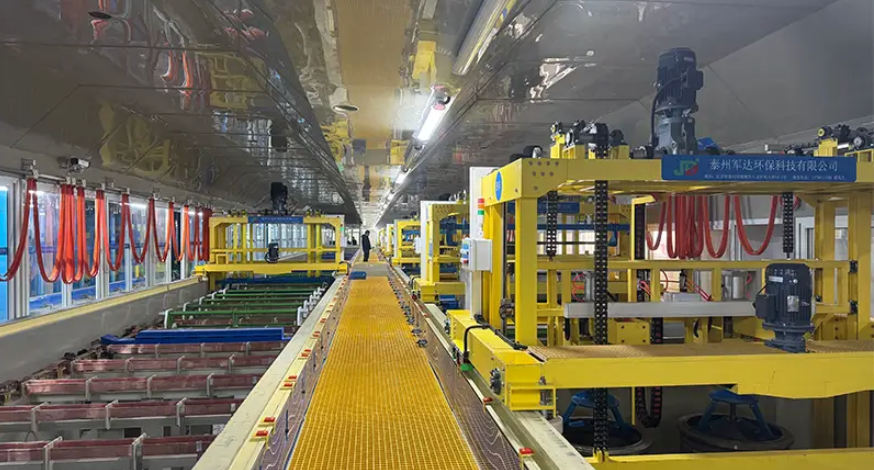
The tour begins where raw steel enters the building. Forklifts move bundled I-beams and sheets into the first bay, the air smelling of cutting oil and hot metal. Workers guide a gantry crane that lowers a fresh frame onto a set of rollers, and within minutes the first sparks fly from a CNC plasma cutter. The floor vibrates underfoot as the line comes alive.
From there, the frame passes through a series of presses and welding stations. Each joint gets a quick pass with a grinder, then a robotic arm lays a precise bead. The noise shifts from a deep rumble to a sharp hiss as components cool. Blueprints taped to nearby posts show the same part repeated across a dozen work orders, a reminder that this is less about craft and more about rhythm.
Finally, the finished steel reaches the plating line. A conveyor dips each piece into a sequence of baths — degreaser, acid rinse, nickel, chrome — each tank glowing under low-hanging lights. The wet parts emerge with a mirror finish, still dripping, and swing toward the drying tunnel. What arrived as raw, grey stock leaves the floor as a component ready for assembly, transformed in under an hour.
Barrel Design Choices That Cut Down on Part Damage
The first thing to look at is how the barrel's interior geometry handles material flow. A slightly tapered compression zone, paired with a gradual transition rather than an abrupt step, prevents pellets from shearing against the wall and breaking into fines. When the root diameter of the screw changes too quickly, it creates high-pressure spikes that can crush fragile resins or damage the screw itself. By keeping the transition length at least five to seven diameters, you give the material room to melt without forcing it through a sharp bottleneck.
Another overlooked choice is the relief angle at the barrel's wear surfaces. Instead of a perfectly straight bore, adding a small relief near the feed throat lets unmelted particles settle without jamming. Coatings also matter more than most people think. A tungsten-carbide lining with a low coefficient of friction will let glass-filled or abrasive compounds slide through without scoring the barrel. Pair that with a hardened screw tip that doesn't protrude past the barrel end, and you cut down on the dings and chips that normally show up after a few thousand cycles.
Tuning Rectifiers and Bath Chemistry for Consistent Zinc Layers
Getting a uniform zinc deposit rarely comes down to a single fix. It’s usually the interplay between how the rectifier delivers current and what’s actually happening in the bath. If the rectifier has more than 5% ripple, you’ll see dull or burned edges even with a healthy bath. Switching to a low-ripple unit or adding filtering often clears up thickness variation without touching the chemistry.
On the chemistry side, zinc metal concentration drifts with anode efficiency and drag-out, so titrate regularly and keep it within the supplier’s narrow band. Too much brightener creates brittle, stressed deposits; too little leaves a matte, uneven plate. A simple Hull cell test each shift is faster than chasing defects after the fact.
Temperature and agitation also matter more than they get credit for. A bath running above 30°C tends to burn at high current density, while cold bath throws poorly in low-current areas. Air agitation should be strong enough to move solution across the cathode face but not so violent that it strips additives. Dial in these variables together, and you get consistent zinc layers run after run.
Scaling Up: When to Add a Second Gantry to Your Plating Operation
Adding a second gantry is rarely a snap decision. It usually follows weeks of watching your current line strain under increasing load, with racks queued at load stations and labor costs creeping upward as shifts stretch to cover overtime. You notice the bottleneck isn't the plating tanks themselves but the movement of parts between them. A single gantry can only be in one place at a time, and once you hit that ceiling, throughput flatlines no matter how fast the chemistry works.
The tipping point often arrives when cycle time variability starts hurting downstream assembly. If your current gantry utilization consistently runs above 80 percent during peak hours, or if you're forced to delay preventive maintenance just to meet order deadlines, the math starts tilting toward expansion. Look at your mix, too. High volumes of small parts may not justify a second gantry, but a rise in large or awkwardly shaped workpieces that require slower, more careful transfers often does. Each extra lift that monopolizes the hoist for ten minutes instead of two is a hidden tax on capacity.
Before committing, map out your projected demand for the next 18 months. A second gantry won't double output automatically; it rebalances movement and eliminates idle tank time, typically yielding 30 to 50 percent more throughput depending on line layout. Also factor in the cost of retrofitting controls, adding safety interlocks, and re-sequencing recipes so both gantries can operate without collisions. If those numbers still make sense against the cost of outsourcing overflow work or running a third shift, then the investment stops being a question of if and becomes a matter of scheduling the downtime.
Why Precision Plating Starts With Rigid Gantry Rails and Controls
Precision plating demands repeatability down to fractions of a micron. Any flex in the motion system translates directly into uneven deposit thickness, edge rounding, or misaligned patterns. A rigid gantry rail eliminates that variable, keeping the plating head exactly where the process recipe expects it — pass after pass.
But stiffness alone isn’t enough. The control loop must react fast enough to hold position against pump pulsations, solution flow, and thermal drift. Tight integration between the rail geometry and servo tuning means the axis behaves like a solid machine tool, not a flexible robot arm. That is what keeps thickness variation under a few percent on complex geometries.
Once the mechanical foundation is rigid and the controls are locked down, the plating process itself becomes the focus. Operators stop chasing position errors and start optimizing bath chemistry, current density, and pulse timing. That shift from fighting the machine to refining the chemistry is exactly why serious plating lines invest in stiff gantry rails and purpose-built motion controls before anything else.
FAQ
The gantry system moves barrels through each process stage with controlled speed and immersion time, reducing variations from manual handling and helping achieve a more uniform zinc layer across high-volume batches.
Automotive fasteners, electrical hardware, and construction components often rely on these systems because they need tight coating tolerances and reliable corrosion resistance without slowing down production.
Yes, the factory offers configurable barrel capacities and adjustable rotation settings, so small screws or larger stampings can be processed without compromising plating quality.
Instead of a one-size-fits-all setup, the engineering team tailors hoist speeds, bath chemistry flow, and barrel perforation patterns to the customer's specific part profile and output goals.
Barrel rotation, current distribution, and solution agitation are tuned together so recessed areas receive adequate plating while flat surfaces stay within specified thickness ranges.
Absolutely. The gantry automation reduces transfer time between tanks and allows continuous processing of multiple barrels, which keeps throughput high while maintaining repeatable results.
The factory supplies detailed maintenance schedules, spare parts kits, and remote diagnostics guidance, helping operators minimize downtime and extend the life of tanks, hoists, and electrical components.
In many cases, yes. The control system and mechanical interfaces can be adapted to work alongside current pretreatment or post-treatment stages, reducing the need for a full line rebuild.
Conclusion
The Gantry Barrel Zinc Plating Equipment Factory has built its reputation on delivering precision plating solutions that hold coating thickness within microns—a demand that separates serious surface finishers from the rest. Their gantry barrel systems integrate rigid rails and closed-loop controls so that every pass through the zinc bath deposits an even layer, even on high-volume runs. Walking through the factory floor, you see this obsession with consistency starting at the steel frame: laser-aligned gantry beams, vibration-damped barrel cradles, and rectifier tuning that reacts to bath chemistry in real time. Barrel design choices, such as optimized perforation patterns and gentle rotation ramps, further reduce part damage while ensuring uniform current distribution. This is not a catalog of generic plating equipment but a working method that treats zinc thickness as a measurable, repeatable outcome rather than a rough approximation.
For shops planning to scale, the factory’s guidance on when to add a second gantry is practical rather than promotional. The decision hinges on rack density, part geometry, and the tolerance window your customers actually demand—not simply on backlog. Their engineers walk you through rectifier sizing, bath filtration upgrades, and rail reinforcement so the second line integrates without disturbing the first. Precision plating, as they demonstrate, starts long before the first barrel dips: it lives in the rigidity of the gantry rails, the latency of the control loop, and the discipline of changing zinc anodes on schedule. By fusing mechanical stiffness with adaptive chemistry control, this factory delivers a plating line that runs like a metrology instrument—quietly, predictably, and within microns.
Contact Us
Contact Person: hayyr
Email: [email protected]
Tel/WhatsApp: 8613082110525
Website: https://www.jundaelectroplating.com