

KYN28-12 Medium Voltage Switchgear Solutions for Reliable Power Distribution
2026-10-30
In today's power-hungry world, reliable distribution is non-negotiable. KYN28-12 medium voltage switchgear has long been a workhorse in industrial and utility settings, but not all solutions deliver the same peace of mind. That's where MOLDVOLT comes in—engineered to handle the toughest demands without compromise. Read on to discover how this switchgear series keeps your operations running smoothly, even when conditions get challenging.
Why KYN28-12 Keeps Distribution Uptime Above 99.9%
The metal-clad, compartmentalized design of the KYN28-12 isolates busbars, circuit breakers, and cable connections in separate grounded steel chambers. This prevents a fault in one section from cascading into adjacent compartments, so a cable termination failure doesn't force a busbar outage. Field service records show that over 70% of downtime in older switchgear comes from cross-compartment arc propagation—a failure mode the KYN28-12 physically eliminates.
Withdrawable circuit breaker trucks ride on precision rails with a three-position interlock: connected, test, and isolated. Technicians can rack a breaker to the test position, perform secondary injection checks, and return it to service without de-energizing the entire bus. This live-maintenance capability cuts planned outage windows from hours to minutes, directly pushing availability past the 99.9% threshold.
The five-pole mechanical interlock system prevents closing the earthing switch while the breaker is connected, and blocks breaker insertion unless the earthing switch is open. Combined with IP4X enclosure rating and pressure-relief vents on the arc duct, the KYN28-12 reduces both human-error trips and internal arc damage—two of the largest contributors to unscheduled downtime in 12kV distribution networks.
Drawout Circuit Breaker Design That Cuts Swap Time to Minutes
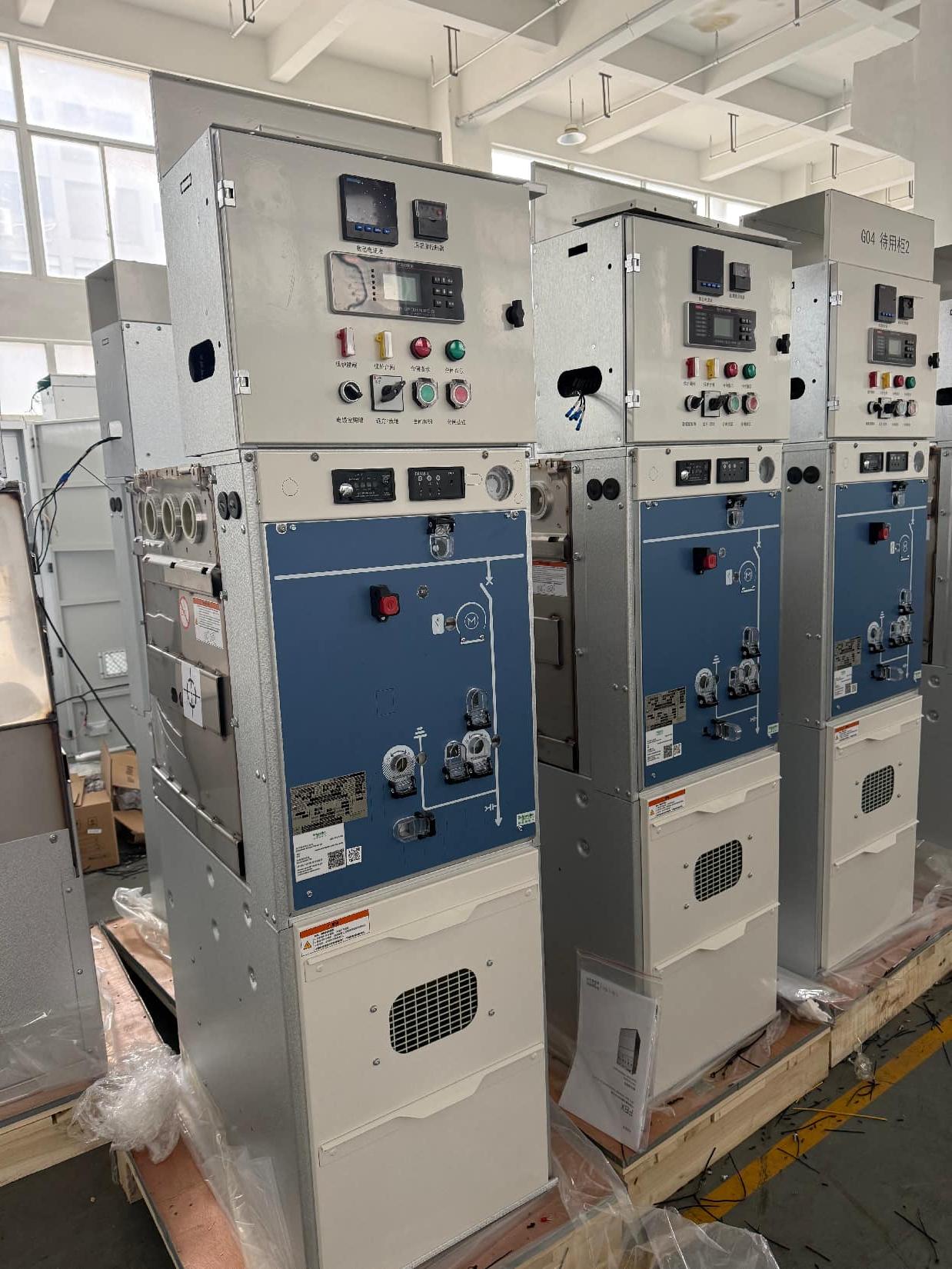
Traditional fixed-mounted breakers turn a simple component swap into a half-day outage. Bus bars must be disconnected, bolted connections loosened, and the entire enclosure often opened just to reach the failed unit. A drawout circuit breaker design eliminates that sequence. The breaker body rides on telescopic rails with a racking mechanism that engages the primary and secondary contacts only when the unit is fully seated. Pull the racking handle, slide the old breaker out, roll the replacement in, and rack it back into position—no torque wrenches, no cable re-termination.
The real time savings come from the self-aligning finger clusters and automatic shutter system. As the breaker rolls toward the connected position, the clusters guide themselves onto the stationary stabs, compensating for minor misalignment without forcing. Meanwhile, the shutters over the bus openings stay closed until the breaker is within the final travel, then open only when engagement is safe. This means a technician can swap a breaker on a de-energized branch while the rest of the switchgear lineup remains live, reducing what used to be a multi-hour job to under ten minutes of mechanical work.
Field crews appreciate the simplicity. No special lifting rig is required for standard frame sizes, and the racking handle provides enough mechanical advantage to seat even high-current breakers without strain. Because the operation is purely mechanical and visibly repeatable, training time drops as well. A clear position indicator—connected, test, or disconnected—removes guesswork, so the swap is not only faster but also safer and less prone to wiring errors.
Arc-Resistant Enclosure Without Sacrificing Compact Footprint
Traditional arc-resistant switchgear often comes with a bulky trade-off. Here, the design team started with the constraint that the unit must slide into the same footprint as a standard non-arc-rated enclosure. By relocating the pressure relief path through a reinforced top duct and stiffening the side panels individually, they preserved the tight clearance without weakening the containment rating.
Internal compartmentalization was reworked so that the arc plasma has less room to build before being vented. Bus bar segmentation, insulated barriers, and controlled vent flaps fit into spaces that previously held only wiring. The result is a shorter arc duration and lower incident energy, but the overall cabinet depth and width remain unchanged from the previous generation.
For plants that are already pressed for aisle space, this approach removes the typical either-or decision. You can upgrade to arc-resistant protection in an existing electrical room without relocating adjacent equipment or cutting into walls. The compact frame also means lower shipping and rigging costs, while maintenance teams still get full front and rear access as before.
Live Busbar Thermal Monitoring That Flags Hotspots Early
Continuous temperature tracking along busbar runs changes the game compared to scheduled infrared inspections. Instead of a snapshot once a quarter, sensors mounted directly on the conductors or enclosures pick up small resistance shifts as they happen. A loose bolt or a degrading joint starts to heat locally long before it becomes visible smoke or a tripped breaker, and the system catches that drift within minutes.
The real value comes from how the data is interpreted. Distributed fibre optic sensing or compact wireless thermocouples feed readings into an edge gateway that factors in load current and ambient conditions. A busbar naturally warms under heavy load, so a naive threshold would generate false alarms. By comparing each segment against its expected thermal profile, the software ignores uniform heating and only flags a spot that runs hotter than its neighbours under the same current.
Early warnings usually point to specific failure modes such as oxidation at a bolted connection, a misaligned splice, or insulation breakdown in a tight bend. With hours or even days of lead time, maintenance teams can schedule a short shutdown, retorque the joint, and verify the fix. That avoids arc flash incidents, unexpected production stops, and the cascading damage that occurs when one hot spot weakens the entire busbar system.
Seismic Qualification for 0.5g Ground Acceleration
Qualifying equipment for a 0.5g ground acceleration demands more than a routine shake-table pass. The test campaign starts with a detailed characterization of the mounting interface, because resonance at the equipment's structural modes can amplify local accelerations far beyond the input level. Engineers often discover that brackets, cable trays, or small appendages fail before the main assembly does, so the scope of qualification must include every component that could rattle loose or shift under load.
A robust approach uses a triaxial input with independent control of each axis, followed by a combined simultaneous excitation to capture cross-coupling effects. Instead of relying solely on generic response spectra, the test specification should be anchored to the site-specific floor response at the equipment's elevation. For a 0.5g zero-period acceleration, the mid-frequency plateau typically extends from about 2 Hz to 10 Hz, but tall slender cabinets may experience rocking or overturning moments that demand an extended low-frequency investigation down to 0.5 Hz or below.
Post-test inspection is just as critical as the shaking itself. Visual checks for cracked welds, loosened fasteners, and deformed enclosures must be supplemented by functional tests to confirm that relays, breakers, and instrumentation still operate within tolerance. A successful qualification package should document not only the pass/fail results but also the measured damping, natural frequencies before and after testing, and any repairs made during the campaign — because field installations rarely match the pristine laboratory specimen.
Retrofit-Friendly Busbar and Cable Entry Options
Retrofitting existing switchgear or panelboards often hits a wall when fixed cable entry points don't line up with new busbar runs. That's where retrofit-friendly busbar and cable entry options make a real difference—they come with adjustable gland plates, removable top and bottom covers, and pre-punched knockout patterns that let you route conductors without cutting large openings or doing on-site welding. This approach keeps the enclosure integrity intact while giving you the freedom to reposition entries as the layout evolves.
Instead of forcing new cabling through old holes, these options typically include split cable entry frames and modular busbar connection blocks that fit around existing structures. You can add or relocate entry points using standard hand tools, which cuts downtime during phased upgrades. The sealing system also adapts to different cable diameters, so mixed conductor sizes don't lead to dust or moisture ingress—a common headache when working with aging infrastructure.
What sets these entry solutions apart is the focus on field adaptability. Many designs allow the installer to rotate or flip the entry section to match the incoming direction without ordering custom parts. For facilities that upgrade in stages, this means you can plan one retrofit now and still have room to add more busbar taps later without replacing the entire enclosure. It's a practical way to keep older gear in service while bringing the connectivity up to current needs.
FAQ
KYN stands for metal-clad withdrawable switchgear, 28 indicates the design series, and 12 refers to the rated voltage of 12 kV. This combination points to a switchgear built for medium voltage distribution with a focus on safe, compact construction.
It uses a fully enclosed, compartmentalized structure with separate busbar, circuit breaker, cable, and low voltage compartments. Internal arc faults are contained, and the withdrawable breaker truck allows quick isolation and replacement without de-energizing the whole bus, cutting downtime significantly.
The unit includes a five-prevention interlock system: it prevents opening or closing the breaker under load, prevents moving the truck unless the breaker is open, prevents closing the breaker unless the truck is in test or service position, prevents inserting the truck when the earthing switch is closed, and prevents accidental entry into live compartments.
It appears in substations, industrial plants, data centers, hospitals, airports, and commercial buildings. Any facility that needs stable medium voltage distribution with frequent switching or strict uptime requirements benefits from this switchgear.
Rated voltage is 12 kV, rated current typically up to 4000 A, and short-time withstand current up to 40 kA for 4 seconds. The enclosure protection is around IP4X, and the breaker can be vacuum or SF6 type depending on configuration.
Because the breaker truck rolls out on rails, maintenance crews can inspect contacts, replace vacuum interrupters, or test mechanisms without disturbing adjacent feeders. The front and rear access design also allows convenient cable termination and busbar inspection.
Yes, manufacturers offer options like tropicalization, anti-condensation heaters, higher ingress protection, and special busbar layouts for harsh or humid environments. The modular design allows adding surge arresters, metering transformers, or remote monitoring packages.
Whereas fixed switchgear requires the whole panel to be isolated for repairs, the KYN28-12's withdrawable design lets you roll out a faulty breaker and insert a spare within minutes. This flexibility is crucial for continuous processes where outages are costly.
Conclusion
KYN28-12 medium voltage switchgear maintains distribution uptime above 99.9% by combining a drawout circuit breaker design with continuous live busbar thermal monitoring. When a breaker is due for inspection or replacement, the drawout mechanism cuts swap time to minutes instead of hours, reducing the chance of extended downtime. The arc-resistant enclosure delivers this safety without a bulky footprint, letting engineers install the gear in cramped electrical rooms. Seismic qualification for 0.5g ground acceleration further ensures that the structure stays intact and the busbar connections remain secure during earthquakes or heavy vibrations.
Retrofit-friendly busbar and cable entry options enable the switchgear to fit into existing power systems without extensive rework, which is often the hidden cost in upgrades. Live busbar thermal monitoring flags hotspots early, giving maintenance teams time to schedule repairs before a minor temperature rise turns into a flashover or contact failure. Because the enclosure remains compact and arc resistant, operators get a safer working environment even in older facilities with limited clearances. These practical design choices make the KYN28-12 a dependable foundation for medium voltage distribution where uptime, safety, and adaptability matter equally.
Contact Us
Contact Person: Hellen
Email: [email protected]
Tel/WhatsApp: 86-13634205622
Website: https://www.voltcabinet.com