

Top 10 Aromatic Acetoxy Intermediates You Should Know for Efficient Organic Synthesis
2026-08-19
At DSL Chemicals, we know that choosing the right intermediate can transform a synthetic route from tedious to streamlined. This curated list of ten aromatic acetoxy intermediates highlights options that combine stability, reactivity, and commercial availability—qualities that matter when you're under deadline. Dive in to see which ones could simplify your next synthesis.
Where Aromatic Acetoxy Intermediates Fit in a Modern Synthetic Workflow
Aromatic acetoxy intermediates have quietly shifted from being routine protecting groups to becoming strategic handles in contemporary route design. Rather than simply capping a phenol, the acetate unit now often serves as a tunable director for C–H functionalization, a redox-active fragment for late-stage diversification, or a placeholder that can be swapped for a coupling partner under mild catalytic conditions. This flexibility places them at the intersection of classical reactivity and modern retrosynthetic logic.
In practice, an acetoxy-substituted arene can enter a workflow at several distinct points. It might be installed early to steer a metalation or halogenation step, then later cleaved to reveal the free hydroxyl for further manipulation. Alternatively, the acetate itself can be activated under photoredox or electrochemical settings to generate aryl radical intermediates, bypassing the need for preformed organometallics. Because the group is stable enough to survive many operations yet labile enough to be removed on demand, it fits well into telescoped sequences and automated synthesis platforms.
For complex molecule assembly, acetoxy arenes also offer a form of orthogonal reactivity that complements boronate esters, halides, and triflates. A well-placed acetate can act as a temporary blocking element that is later converted into a leaving group for cross-coupling, or it can serve as a directing group that is traceless after C–H activation. This layered utility means that a single acetoxy intermediate can influence bond construction at multiple stages, reducing step count and avoiding protecting group redundancy in modern synthetic workflows.
The Acetoxy Moiety as a Low-Profile Workhorse in Ring Functionalization
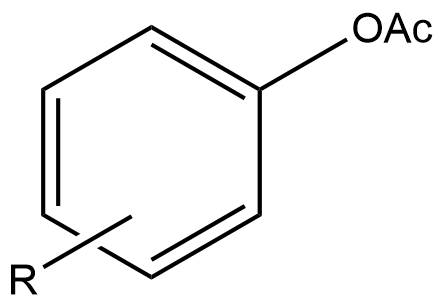
In the crowded toolbox of ring functionalization strategies, the acetoxy group rarely grabs headlines. Yet this unassuming substituent—just a methyl group tethered to a carbonyl through an oxygen bridge—pulls off a surprising variety of transformations without demanding special handling or exotic conditions. Its low steric footprint lets it sit quietly on aromatic or heteroaromatic rings until the right moment, at which point it can be swapped, migrated, or leveraged as a directing handle. The result is a workhorse that often outperforms flashier activating groups precisely because it stays out of the way.
One reason the acetoxy moiety earns its keep is its ability to serve as a traceless placeholder. In electrophilic aromatic substitution, for instance, an acetoxy group can initially deactivate a ring position, then later be removed or converted after other sites have been functionalized. This temporal control is invaluable in complex molecule synthesis, where the order of ring edits matters more than the raw reactivity of any single step. Because the acetoxy group is readily introduced through simple esterification and cleaved under mild hydrolysis, it integrates smoothly into multi-step sequences without forcing protecting group gymnastics.
Beyond its role as a passive masking group, the acetoxy substituent actively participates in metal-catalyzed ring functionalization. Its oxygen atom can coordinate to palladium, ruthenium, or rhodium catalysts, guiding C–H activation to ortho or meta positions that would otherwise be difficult to reach selectively. After the metalation step, the acetoxy group can either remain as a spectator or undergo decarboxylative coupling, releasing carbon dioxide and leaving behind a new bond. This dual identity—directing group today, leaving group tomorrow—makes it a remarkably efficient partner for building substituted rings without adding unnecessary molecular bulk.
Matching Aromatic Acetoxy Intermediates to Your Reaction Conditions
Selecting the right aromatic acetoxy intermediate often starts with solvent polarity. In nonpolar media, intermediates bearing longer alkyl chains or unsubstituted phenyl rings tend to stay soluble, whereas electron-poor aromatics can be sluggish unless paired with a polar aprotic solvent. A quick solubility screen in the actual reaction solvent saves more time than chasing yields later.
Temperature tolerance is another practical filter. The acetoxy group can undergo thermal elimination or Fries-type rearrangement above roughly 120 °C, so if your protocol demands prolonged reflux in a high-boiling solvent, look for intermediates with electron-withdrawing substituents on the ring. These tend to resist unwanted acyl migration and keep the desired reactive site intact.
Catalyst compatibility deserves equal attention. With Lewis acids or palladium catalysts, the acetoxy unit can act as a directing group or a leaving group depending on its electronic environment. For cross-coupling reactions, test whether the intermediate competes with the intended aryl halide or triflate. A small set of control experiments at the start can reveal whether the acetoxy fragment is innocent or actively interfering.
Ten Aromatic Acetoxy Intermediates That Repeatedly Earn Their Keep
Few functional groups walk the line between stability and reactivity quite like the aromatic acetoxy unit. It sits quietly on the ring, biding its time until a mild base or a clever catalyst invites it to leave — and when it does, the resulting phenolate or aryl radical rarely disappoints. That controlled departure makes these intermediates the quiet workhorses of multi-step syntheses, especially where a hydroxy group needs protection without the fragility of a silyl ether or the stubbornness of a methyl cap.
What keeps chemists coming back is the sheer predictability. Run a Suzuki coupling with an acetoxy-substituted aryl bromide and the ester survives untouched; switch to a Buchwald–Hartwig amination and the same holds true. Then, at the chosen moment, hydrolysis strips the acetyl away cleanly, unveiling a phenol that can be alkylated, oxidized, or pushed through a Smiles rearrangement. The acetoxy group doesn't just protect — it choreographs, allowing oxidation-state adjustments downstream that a free phenol would sabotage.
Where these intermediates truly earn their keep is in the unglamorous middle of a route: the step that no one names in the paper but everyone notices when it fails. An acetoxy group on a crowded naphthalene core steers electrophiles to the less hindered position, then leaves without drama. On a tyrosine mimic, it masks a phenolic oxygen long enough for a peptide coupling to proceed. Even in material science, acetoxy-functionalized monomers crosslink with a clean, predictable exotherm. They aren't flashy, but they refuse to be replaced.
Avoiding the Usual Stability Traps with Acetoxy Building Blocks
Acetoxy groups often masquerade as innocent protecting handles, yet their lability in mildly basic or even buffered aqueous media can quietly derail a sequence. One of the more frequent missteps is carrying an acetoxy intermediate through a coupling step that demands even trace nucleophilic base—transesterification with the solvent or a nearby hydroxyl occurs long before the intended acyl transfer.
A subtler trap comes from neighboring-group participation. When an acetoxy sits within reach of a secondary alcohol or an amine, it readily forms a cyclic orthoester or an oxazoline-like intermediate. This can scramble stereocenters or lock the molecule into an unreactive conformation, so it pays to deliberately shield that proximity by choosing a bulkier ester or running the reaction at lower temperature to suppress the anchimeric assistance.
Storage and workup habits also matter more than the synthetic design. Wet solvents, prolonged exposure to silica gel, or even a slightly acidic quench will slowly erode the acetoxy cap. A quick NMR check before committing the building block to a key bond-forming event is cheap insurance, and swapping in methyl tert-butyl ether for ethyl acetate during extraction avoids an unnecessary ester metathesis.
From Acetoxy Intermediate to Final Target Without Drifting Off Route
Keeping a synthesis on track from an acetoxy intermediate to the final target demands more than just following a drawn arrow. It means knowing which side reactions are most likely to pull the sequence off course, and deliberately shutting those doors before they open. The acetoxy group itself can be a quiet troublemaker: under basic conditions it may undergo elimination or migration, while under acidic conditions it can hydrolyze at the worst possible moment. A route that stays on target will often protect or temporarily mask this group only if needed, then choose reaction conditions that leave it untouched until the exact stage where its removal or transformation is desired.
The real test comes when you scale up or change one reagent for another. What worked in a small flask might drift off route because a supposedly innocent byproduct starts coordinating to the catalyst, or a trace of water changes the selectivity. Keeping the final target in view means checking each intermediate against a simple question: does this step bring me closer without creating a new functional group that now has to be corrected later? Sometimes the best way to avoid drifting is to redesign the order of steps so that the acetoxy intermediate is introduced only after all harsh or incompatible chemistry is finished.
At the end, reaching the final target without drifting off route is not about luck or forcing a reaction to behave. It is about maintaining a clear map of what the acetoxy group will tolerate, and what it will not, while every purification and every solvent choice is made with the next step already in mind. A successful synthesis feels inevitable only in retrospect; during the work, it is a steady discipline of small decisions that keep the molecule on the path you chose, rather than letting side paths quietly replace it.
FAQ
The acetoxy group pulls electron density away from the ring just enough to tame over-reactive positions, while still being easy to remove under mild basic conditions. This balance lets you run halogenations, nitrations, or cross-couplings at the desired site without scrambling the molecule, and the protecting group rarely interferes with metal catalysts.
Compounds like 4-acetoxybenzaldehyde, 2-acetoxyphenylacetic acid, and 6-acetoxy-2-naphthoic acid tend to be overlooked because they look like simple esters, but they already carry the acetate handle and avoid a separate protection step. Using them as starting materials can cut two or three operations from a route.
Unlike a methoxy group, which strongly directs ortho/para through resonance, the acetoxy group is a moderate deactivator that still directs ortho/para but at a much slower rate. This often prevents over-substitution and gives cleaner mono-functionalized products when you need to add only one group to a reactive ring.
A mild acetylation with acetic anhydride and a catalytic amount of DMAP in dichloromethane works well for phenols, while for direct C-H acetoxylation on arenes you can use palladium catalysis with PhI(OAc)2 as the acetate source. Both approaches keep temperatures low and tolerate esters, nitriles, and even some heterocycles.
If you need a protecting group that survives hydrogenation conditions but still comes off quickly with aqueous base, acetoxy is often the best pick. Benzyl ethers require hydrogenolysis that can reduce other functional groups, and silyl ethers can be too labile during acidic workups, while acetates sit in a comfortable middle zone.
The biggest issue is unintended hydrolysis if the reaction mixture gets too basic during quenching. Acetates can also migrate from oxygen to adjacent nucleophilic positions under thermal stress, so keeping temperatures below 80°C and using buffered aqueous washes usually prevents both problems.
They can participate directly in many cases. The acetate group is stable enough to survive Suzuki-Miyaura and Buchwald-Hartwig conditions, and after coupling you can hydrolyze it in one pot to reveal the phenol. This saves an entire deprotection and re-protection cycle and is especially handy for parallel library synthesis.
Acetoxy-protected salicylaldehydes, acetoxyindoles, and acetoxycoumarins show up repeatedly in med-chem routes. They allow late-stage diversification of phenols without rewriting the synthesis, and many are available commercially at multi-gram scale with consistent purity, which makes them reliable starting points for SAR studies.
Conclusion
Aromatic acetoxy intermediates have carved out a quiet but essential role in modern synthetic workstreams. They rarely headline a retrosynthetic plan, yet they solve a persistent issue: installing oxygen-based functionality on an aromatic ring without locking you into harsh conditions or fragile protecting groups. The acetoxy group behaves as a low-profile workhorse, enabling ring functionalization through electrophilic substitution, cross-coupling, or directed metalation while staying dormant until the phenol is deliberately released. Matching a given acetoxy building block to your reaction conditions is not a formality, since some tolerate strong bases or oxidants while others demand mild catalytic settings, and choosing wrongly can derail an entire sequence. The ten aromatic acetoxy intermediates highlighted here persist in real synthetic practice because they cover that full spectrum, from electron-rich to electron-poor rings and from bench-stable solids to highly reactive partners that need careful handling.
Most stability traps associated with acetoxy building blocks are avoidable once the patterns are recognized: hydrolysis during aqueous workup, migration under Friedel-Crafts conditions, or premature deprotection during metal-catalyzed steps. The ten entries selected here have been stress-tested in actual lab workflows, so each one pairs a specific aromatic core with an acetoxy placement that resists the common failure modes. Equally important, they keep a route from drifting off course. Instead of introducing a phenol late and then fighting oxidation or over-functionalization, you can carry the acetoxy group through several transformations and cleave it exactly when the final target requires. That kind of dependability explains why these intermediates recur across medicinal chemistry, materials research, and natural product synthesis without becoming the center of attention.
Contact Us
Contact Person: Wei Zhang
Email: [email protected]
Tel/WhatsApp: 862163529955
Website: https://www.dslchem.com