

Top Sintered Silicon Carbide Materials for Demanding Industrial Applications
2026-09-30
When industrial processes push materials to their absolute limits, sintered silicon carbide stands apart—not just for its hardness and thermal stability, but for how precisely it can be engineered to meet unforgiving conditions. Yet even within this elite category, not all grades perform equally. From high-temperature furnace components to aggressive chemical handling systems, the right formulation can mean the difference between continuous uptime and costly downtime. This guide cuts through the noise to examine the top sintered silicon carbide materials currently proving their worth in the field—including several advanced options from HUAYI TECH, a manufacturer quietly redefining what engineers should expect from this ceramic. Whether you're spec’ing seals, bearings, or wear-resistant liners, what follows will help you match the material’s microstructure to the demands of your toughest applications.
Why Sintered Silicon Carbide Excels in Abrasive and Corrosive Environments
Sintered silicon carbide earns its reputation the hard way—by holding up where most materials fall apart. In abrasive conditions, the surface doesn't just resist wear; it actively shrugs off sliding grit, particle impact, and high-velocity erosion. The key lies in its extremely fine, interlocking grain structure. Rather than losing material layer by layer, the exposed grains lock together so tightly that abrasives struggle to find a weak entry point. This keeps dimensional stability intact long after hardened steels or even tungsten carbide would show measurable loss.
Corrosive environments tell a similar story, but through a different mechanism. Sintered silicon carbide grows a passive oxide skin that blocks chemical attack from acids, alkalis, solvents, and molten salts. Unlike metal passivation layers that can flake or dissolve under thermal cycling, this oxide layer remains stubbornly bonded. The result is a ceramic that shrugs off aggressive media at temperatures that would accelerate corrosion in stainless steels or exotic alloys. Even in mixed attack—hot acid laden with abrasive particles—the material doesn't pit, crack, or lose mass at a predictable rate.
What sets sintered silicon carbide apart from reaction-bonded or clay-bonded versions is density. The sintering process closes nearly all internal porosity, leaving no channels for aggressive fluids to migrate into the body. In abrasive service, that density also means there are no pre-existing flaws where cracks can start. Engineers often select it for seal faces, pump shafts, and sand-blasting nozzles because the component doesn't simply survive longer—it keeps the same surface finish and geometry, which protects the entire system from drift and failure.
The Role of Microstructure in Tailoring Hardness and Thermal Conductivity
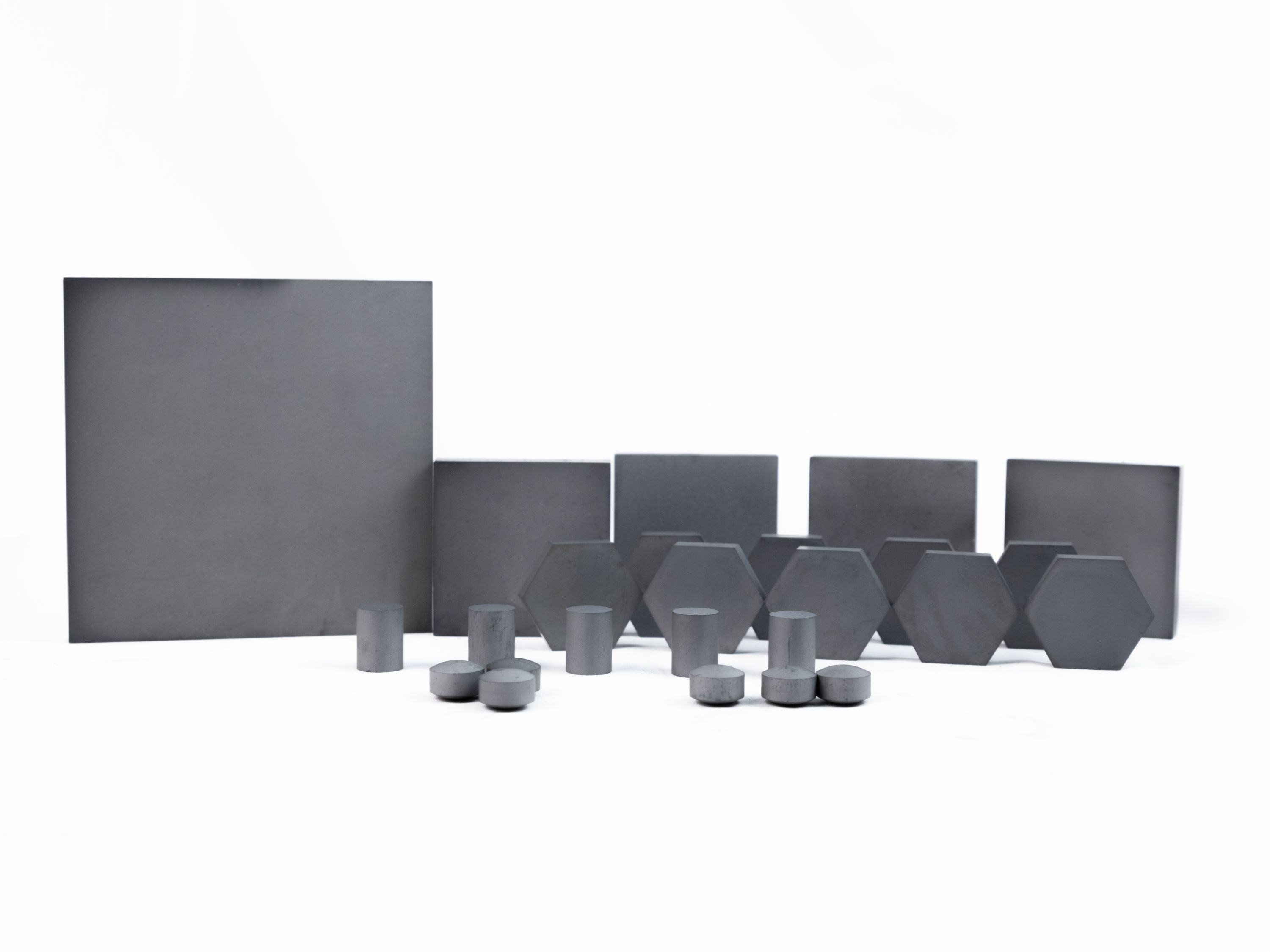
Microstructural design influences hardness and thermal conductivity through separate physical pathways. Hardness rises when grain boundaries, second-phase particles, and dislocation networks restrict plastic flow; the Hall-Petch effect is the most familiar example, but precipitate spacing and solute misfit also matter. Thermal conductivity, by contrast, is controlled by how freely electrons and phonons travel. Interfaces, point defects, and lattice strain scatter these carriers and lower conductivity, which means the same features that strengthen a material often degrade its ability to conduct heat.
The practical challenge lies in finding microstructures that do not simply trade one property for the other. Finely dispersed coherent precipitates can raise hardness with a smaller penalty to thermal conductivity than incoherent particles, because coherent interfaces scatter phonons less strongly. Grain boundary engineering offers another route: a moderate grain size may retain decent strength while avoiding the severe boundary scattering that comes with nanocrystalline structures. In some alloys, a bimodal grain distribution combines coarse grains for conductive pathways and fine grains for load-bearing capacity.
Processing history determines which of these compromises is achievable. Severe plastic deformation produces high dislocation densities and ultrafine grains, but the resulting thermal conductivity drop is often too large for heat-sink applications. Controlled aging or thermomechanical treatments can introduce anisotropic precipitate alignments that hinder dislocation glide in one direction while leaving relatively open channels for heat flow in another. The most effective microstructures tend to be deliberately heterogeneous, with local features tuned to the specific demands of hardness and thermal transport.
Pressureless Sintering vs. Hot Pressing: What Changes in Real-World Performance
In real production, the choice often comes down to what "fully dense" actually means for the part. Pressureless sintering can reach 95–98% theoretical density in many ceramics, but the last few percent are where porosity hides. Hot pressing applies uniaxial pressure during heating, collapsing those remaining pores and typically pushing density above 99%. That difference shows up as measurable gains in flexural strength and wear resistance, not just lab numbers.
The trade-off appears in shape complexity. Pressureless sintering tolerates intricate geometries, undercuts, and large batches in a single furnace run because no die constrains the part. Hot pressing requires a graphite die and uniaxial force, so parts are usually simple discs or blocks. Real-world performance thus depends on whether you need a near-net shape or can accept post-sintering machining, which erases some of the density advantage at the surface.
Thermal management also shifts. Hot pressing often allows lower sintering temperatures and shorter holds because pressure assists diffusion. That can preserve finer grain sizes, improving hardness and fracture toughness. However, pressureless sintering scales better for high-volume production, and the absence of die wear means more consistent lot-to-lot dimensions. In practice, many manufacturers reserve hot pressing for high-value components where the extra 1–2% density justifies the higher tooling cost.
Unexpected Industrial Niches Where Sintered SiC Outperforms Metals
When engineers think of components that endure brutal abrasion, chemical attack, or thermal shock, metals like hardened steel or exotic alloys usually come to mind. Yet sintered silicon carbide quietly handles jobs that turn these metals into scrap. Consider the insides of slurry pumps used in mining operations. Metal impellers and casings wear down in weeks from high-speed particle impact, while sintered SiC parts run for months without measurable loss. The same holds true in coal-fired power plants, where burner nozzles made from this ceramic survive fly ash erosion that erodes stainless steel within a single maintenance cycle.
Another overlooked niche is precision mechanical seals for aggressive fluids. In chemical processing, pumps often move hot sulfuric acid or abrasive crystallizing slurries. Metal seal faces pit and seize under such conditions, causing leaks and unplanned downtime. Sintered SiC seal rings, however, maintain a mirror finish and dimensional stability even at temperatures where metal alloys begin to soften. The material's high thermal conductivity also dissipates frictional heat faster than tungsten carbide, preventing thermal cracking in dry-running or poorly lubricated startup conditions.
Perhaps the most surprising application lies in semiconductor manufacturing equipment. Inside plasma etch chambers, components like focus rings and gas distribution plates face ion bombardment that sputters away aluminum and even yttria-coated metals. Sintered SiC resists this erosion while introducing virtually no particle contamination—critical for chip yields. Spacecraft thrusters and nuclear reactor control rod sleeves also rely on this ceramic, where its neutron transparency and resistance to radiation embrittlement give it an edge over stainless steel or zirconium alloys. In each case, the switch to sintered SiC isn't about chasing marginal gains; it's about solving a failure mode that metals simply cannot survive.
Reading Between the Specs: How to Spot a Quality Sintered SiC Grade
Spec sheets make every sintered silicon carbide grade look nearly identical—density around 3.15 g/cm³, hardness off the charts, flexural strength in the same ballpark. That's where the trouble starts. The numbers most buyers fixate on are usually measured under ideal lab conditions and rarely reflect how the material behaves after six months in a slurry pump or kiln furniture application. Instead of comparing headline values, ask for the microstructural details: average grain size, grain size distribution, and the presence of any residual silicon or carbon inclusions. A quality grade will show uniform, fine, equiaxed grains—typically in the 2–6 µm range—with minimal free silicon pooling at triple junctions.
Another tell is porosity. Even a fraction of a percent of closed porosity can create crack initiation sites under thermal shock or mechanical load. Request a polished cross-section image or a mercury intrusion porosimetry report. If the vendor hesitates, that's a signal. Also look at the fracture mode: a high-grade sintered SiC should exhibit transgranular fracture with a relatively flat, featureless surface at moderate magnification, not a jagged intergranular failure that points to weak grain boundaries or excessive sintering aids. The distribution of sintering aids matters more than the total amount.
Finally, reliability data separates marketing grades from engineering grades. Ask for Weibull modulus values from a statistically meaningful sample size—not just a single bend test. A Weibull modulus above 10 suggests consistent processing, while values below 6 indicate scatter that will bite you in production. If possible, run a side-by-side abrasive wear test against your current material using the same slurry or media. Specifications are a starting point; the real grade reveals itself in polished micrographs, porosity distributions, and batch-to-batch consistency.
Designing with Sintered SiC: Common Mistakes That Shorten Component Life
One of the most frequent oversights is treating sintered SiC like a ductile metal. The material’s high hardness and wear resistance come with an unforgiving brittle failure mode, so sharp internal corners and abrupt cross-section changes act as crack initiation sites. A fillet radius that would be acceptable in steel can still concentrate enough stress to trigger sudden fracture in SiC, especially under cyclic thermal or mechanical loading.
Thermal gradients also get underestimated. While SiC conducts heat well, its low fracture toughness means that non-uniform heating or cooling can generate localized tensile stresses far beyond safe limits. Components that are clamped rigidly against materials with different coefficients of thermal expansion often develop hidden tensile zones at interfaces, leading to delayed cracking that field engineers rarely attribute to the original design.
Finally, tolerancing and surface finish are not just manufacturing concerns—they are design decisions. Overly tight press fits or point loading during assembly can introduce microcracks that remain invisible until service. A better approach is to specify generous lead-in chamfers, controlled interference levels, and polished surfaces in high-stress regions, then verify with proof testing that the part survives a load envelope beyond its worst expected condition.
FAQ
Sintered silicon carbide offers a hardness close to that of diamond, which allows impellers, shafts, and bearing surfaces to resist abrasion even when pumping slurries containing hard particles. The material's low friction coefficient also reduces heat generation and wear at sliding interfaces, extending service intervals without the need for additional lubricants.
Unlike many ceramics that behave as thermal insulators, sintered SiC conducts heat efficiently. This lets tube walls transfer thermal energy quickly while still handling aggressive acids or alkalis. The combination keeps fouling low and allows thinner wall sections, which further improves heat transfer and reduces pressure drop across the exchanger.
Direct sintered SiC is produced without a residual silicon phase, so it retains high strength and corrosion resistance at temperatures approaching 1600°C. Reaction bonded SiC contains free silicon that melts around 1400°C and is vulnerable to attack in strong oxidizing media. For high-temperature mechanical seals or furnace components, direct sintered grades are usually the safer choice.
Its combination of near-universal chemical inertness and mechanical robustness means it can handle concentrated acids, bases, and solvents at temperatures that would degrade most metals or plastic linings. It also resists erosion from particle-laden fluids, so a single sintered SiC component can replace multiple layered protection systems and cut maintenance downtime.
In sliding contact under high load or in hot abrasive slurries, sintered SiC lasts longer than alumina because of its higher hardness and better thermal shock resistance. Compared with zirconia, SiC maintains its strength at much higher temperatures and does not suffer from low-temperature degradation in wet environments, making it a preferred material for mechanical seals, journal bearings, and kiln furniture.
Small amounts of boron and carbon help densify SiC during liquid-phase or solid-state sintering by reducing grain boundary energy and removing surface oxides. If the additive balance is off, grains can grow excessively or residual porosity remains, which lowers flexural strength and corrosion resistance. Tight control of these additives is what separates industrial-grade sintered SiC from less consistent batches.
A fine, uniform grain structure without free metal phases allows sintered SiC to withstand rapid temperature swings and oxidizing flames without cracking. Coarser grains or secondary phases can act as weak points where thermal stress concentrates. For burner nozzles, a grade with submicron starting powder and minimal residual porosity typically delivers the longest service life.
Engineers should match the seal face flatness and surface finish to the material's hardness, and avoid sharp corners or sudden section changes that create stress risers. The mating face material also matters: a hard counterface such as carbon-graphite or another SiC grade usually works best. Finally, the specific grade—whether solid-state or liquid-phase sintered—should be chosen based on the chemical environment and maximum operating temperature.
Conclusion
In demanding industrial settings, sintered silicon carbide (SiC) earns its reputation less through any single headline property than through a rare combination of abrasion tolerance, chemical inertness, and thermal stability that holds up where metals and oxide ceramics falter. The material's resistance to abrasive slurries and aggressive acids stems from the same tightly bonded covalent structure that also lets engineers dial in hardness and thermal conductivity by adjusting grain size, sintering aids, and secondary phases. Pressureless sintering tends to deliver a more uniform, near-net-shape component with consistent bulk properties, whereas hot pressing packs grains closer and often raises density and strength, though it restricts geometry and can introduce anisotropic behavior that shifts real-world wear and heat transfer in ways that spec sheets alone rarely capture.
Beyond pumps, seals, and blast nozzles, sintered SiC quietly outperforms metals in niches like semiconductor wafer handling, high-temperature heat exchangers, and precision components for fuel cells, where low thermal expansion and resistance to galling prevent failures that stainless or tool steel cannot avoid. To separate a reliable grade from a marginal one, look beyond the headline flexural strength and ask about porosity distribution, free silicon content, and whether the manufacturer reports data from sintered test coupons rather than idealized lab samples. On the design side, many premature failures trace back to sharp internal corners, overly aggressive shrink fits, or ignoring the material's lower fracture toughness compared with ductile metals; leaving generous radii, avoiding tensile stress concentrations, and working with suppliers early on thermal expansion mismatches can add years to component life.
Contact Us
Contact Person: Junting Leo
Email: [email protected]
Tel/WhatsApp: +86 18615009766
Website: https://www.huayimaterial-china.com/