

Type B RCD Supplier Guide: How to Choose Reliable Residual Current Devices
2026-08-17
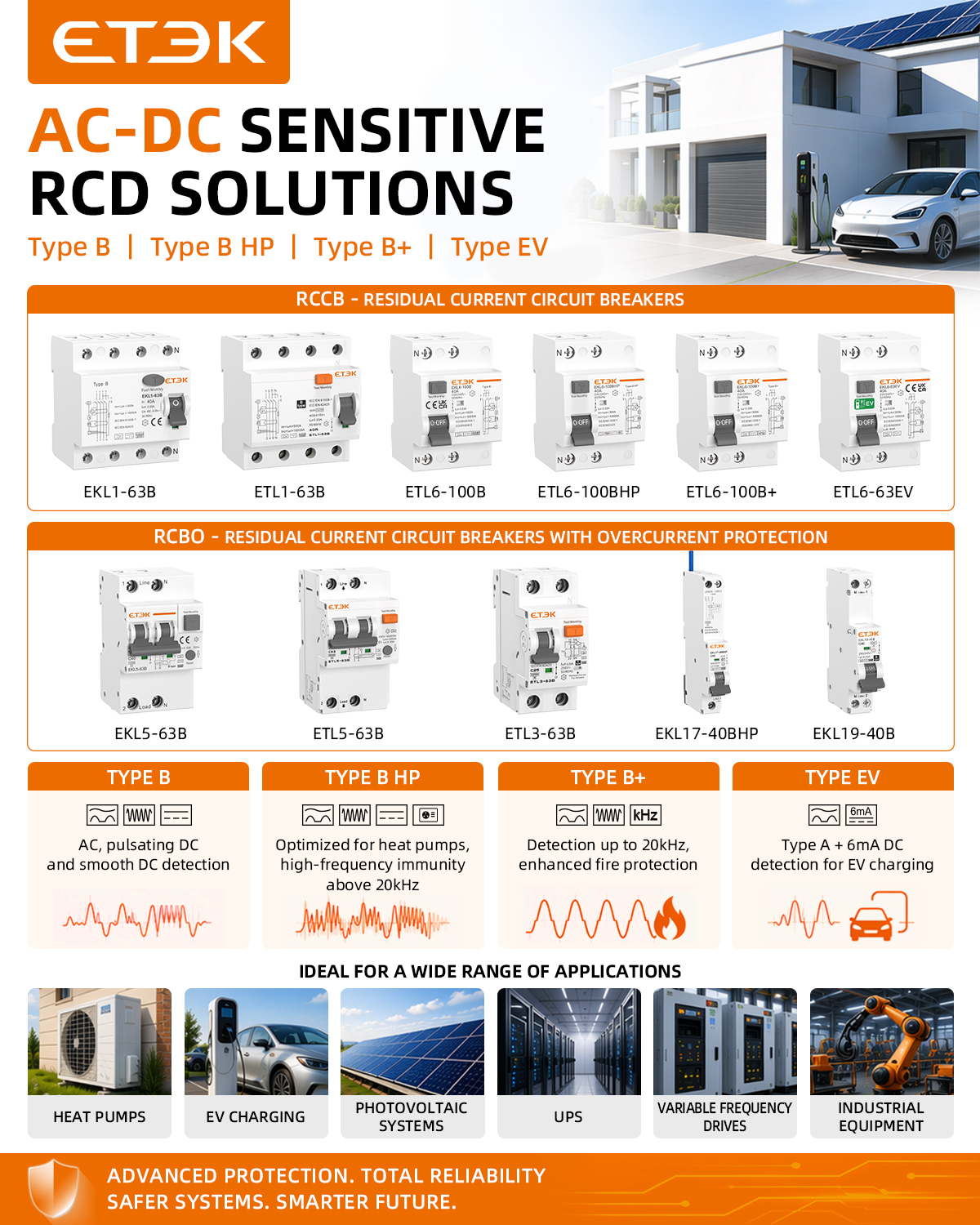
Selecting the right Type B Residual Current Device (RCD) is no longer a simple checkbox on a spec sheet. With the rise of EV chargers, solar inverters, and variable frequency drives, protection against smooth DC residual currents has become a genuine safety priority. Yet, far too many buyers still rely on outdated selection criteria—or worse, assume all RCDs are created equal. That’s where this guide comes in. We’ll cut through the technical noise and give you a practical framework for evaluating suppliers, testing certifications, and real-world performance. Along the way, you’ll see why experienced engineers increasingly turn to manufacturers like ETEK for reliable, application-tested Type B RCDs. Whether you’re an OEM, panel builder, or electrical contractor, the next few minutes could save you from costly missteps.
The DC Leakage Gap Hiding in Most Electrical Designs
Most design reviews chase down the obvious culprits—switching losses, inrush currents, and quiescent draw—while a quieter problem slips through: direct current leaking through materials that are supposed to insulate. Every board has parasitic paths across PCB surfaces, through solder mask, under conformal coating, and inside component bodies. In a dry, clean lab these leakages often stay in the nanoamp range, but humidity, dust, flux residue, and aging can push them into the microamp territory. Since none of these paths appear on a schematic, they rarely make it into simulation models or design margin calculations.
The gap hides in the difference between the insulation resistance you assume from a datasheet and the resistance that actually exists on an assembled board. Bulk resistivity numbers for FR-4 or solder mask are measured under idealized conditions, not after reflow, washing, and weeks of field exposure. A high-impedance node biased by a 10-megaohm divider can be pulled off target by a leakage path of a few hundred megaohms—an error that SPICE will never show unless you explicitly model it. That is why circuits drawing less than a microamp can pass every bench test and still drift or drain batteries once they are deployed in the real world.
Breaking Down the Trip Curve – What Your Load Actually Demands
Circuit breakers don’t simply snap open the instant current exceeds a fixed number. The trip curve maps out exactly how long a breaker waits before interrupting the flow, and that timing shifts depending on how far the overload goes. A mild overcurrent might be tolerated for several minutes, while a hard fault forces a near-instant response. Understanding this uneven timeline is the first step toward matching protection with actual load behavior.
Most curves are plotted with current multiples on the horizontal axis and time on the vertical, often on a log-log scale. The shape isn’t accidental. Thermal elements bend gradually to handle normal inrush spikes from motors or transformers, while magnetic trips cut sharply at higher multiples to clear dead shorts before wiring overheats. What you see between those two regions is the real personality of the breaker—how patient or impatient it is with your equipment.
Instead of treating the curve as an abstract spec sheet, read it as a demand profile. A pump starting under load may ride the thermal edge for a few seconds without tripping, while a stalled compressor might jump straight into the magnetic zone. Matching that pattern to your actual startup and fault behavior prevents nuisance trips without sacrificing safety, leaving you with a breaker that respects the load’s true rhythm.
Certification Labels That Are Easy to Fake or Misread
Many shoppers assume a green leaf or a smiling farmer on a package means the product has been thoroughly vetted. Yet some of the most recognized-looking labels are little more than marketing graphics created by the brand itself. Without a third-party verifier or a public standard, the symbol can be slapped on anything from plastic water bottles to conventionally grown produce, leaving buyers with a false sense of ethical or environmental assurance.
The problem gets worse with labels that sound official but have vague definitions. Words like “natural” or “eco-friendly” are not tightly regulated in many regions, so a cereal box can carry a pastoral logo while still containing synthetic additives. Certifications that require only a one-time payment or a brief online questionnaire can be earned without any on-site inspection, making them easy to fake. Meanwhile, legitimate seals with strict criteria often get drowned out by a sea of look-alike badges that rely on color psychology and familiar icons instead of real accountability.
Consumers can protect themselves by looking for the certifier’s name, not just the graphic. A trustable label usually lists an independent organization, a specific standard number, or a QR code that leads to a public database of certified products. If the only information is a pretty picture and a vague promise, that should raise a red flag. In a marketplace crowded with eco-marketing, the absence of verifiable details is often the clearest sign that a label is designed to be misread.
Why a Bench Test Can't Replace Real-World Fault Simulation
Bench tests are great for checking a component's baseline behavior, but they operate in a vacuum. On a bench, you control the input voltage, temperature, and load—so every failure looks predictable. Real-world faults, though, rarely show up as a clean step change. You get intermittent shorts from vibration, ground loops caused by nearby equipment, or a failing sensor that drifts only when it's hot and humid. A bench rig simply doesn't recreate those messy, overlapping conditions, so passing a bench test tells you very little about how the system will behave when a wiring harness chafes against an engine block at 3,000 RPM.
Another blind spot is timing. Bench tests let you pause and measure at your own pace, but real faults happen in milliseconds and often cascade. A relay that chatters after a voltage dip might not trip any lab threshold, yet out in the field it can corrupt a CAN bus message and take down an entire subsystem. You need to see that sequence unfold in situ—with real cable lengths, real electromagnetic interference, and real load dynamics—before you can trust your fault handling. Simulating the fault on a bench often means injecting a known error into a simplified circuit, which ends up validating your test script more than the product.
Finally, there's the human factor. Real-world fault simulation forces you to react the way a technician would: poking around a live panel, swapping a suspect module, or bypassing a safety interlock to get home. Those actions introduce variables no bench test accounts for—loose connectors, crossed wires, or a ground strap that gets left off. If you only rely on bench testing, you end up with a design that's lab-perfect but field-fragile.
Installation Habits That Sabotage Residual Current Protection
One of the most damaging habits is wiring the neutral conductor incorrectly — for instance, connecting the outgoing neutral to the wrong busbar or sharing a neutral between circuits. This bypasses the current balance that an RCD relies on, so the device simply won't trip even when leakage occurs. It's the kind of mistake that gets hidden behind a faceplate and only shows up after someone gets a shock.
Another common practice is using the test button as a quick fix. Installers sometimes press it during commissioning, see it trip, and assume everything is fine — but then they ignore nuisance tripping later. Instead of hunting down the real cause, like a damp appliance or a pinched cable, they swap in a higher-rated RCD or, worse, bridge the device entirely. That turns a safety component into a decoration.
Overloading a single RCD with too many circuits is also a silent saboteur. When one faulty appliance trips the whole board, users get frustrated and start demanding a bypass. Electricians who give in and remove the RCD from the circuit, or install a lower-sensitivity type just to stop callbacks, are effectively deleting the protection the design intended. The habit of valuing convenience over safety never ends well.
Interrogating Your Supplier – The Questions That Reveal True Reliability
A supplier's reliability rarely shows up in a glossy brochure or a well-rehearsed pitch. Start by asking for the story behind their last big failure. Not the sanitized version—the real one. Which shipment went wrong, why did it happen, and what did they change afterward? If they squirm or suddenly become vague, that's your answer. Dependable partners talk about their mistakes with the same clarity as their wins, because they know you'll find out eventually.
Next, ask them to name a client who stopped working with them. It feels rude, but it's the fastest way past the marketing layer. Listen for how they describe the exit—do they blame the client, or do they own a piece of it? Then dig into their inspection data, not the summary chart. Request the raw rejection counts from the last three production runs. A supplier who hands over unpolished numbers, including the week where defect rates spiked, is one you can actually build a supply chain on. The ones who only show you the trophy shelf are hiding the scrap bin.
FAQ
Look for third-party certification marks from bodies like VDE, TÜV, or UL, and ask the supplier for the test certificate that references IEC 62423 or equivalent. A genuine Type B mark means the unit has passed smooth DC tests, not just a paper claim.
Three-phase EV charging stations, PV inverters without galvanic isolation, UPS systems, and variable frequency drives often produce smooth DC residual currents. If the equipment manufacturer specifies Type B, or if the installation has DC-capable power electronics, Type A will not provide reliable protection.
Nuisance tripping usually comes from poor filtering or aggressive internal thresholds that react to harmless high-frequency leakage from inverters. Ask the supplier about the device's immunity to transient leakage and inrush, and if possible test it on your actual load profile before committing to a large order.
It is often overlooked but critical. Many devices only maintain accurate tripping within a narrow band, typically -5°C to +40°C. If the unit will sit inside a hot cabinet or outside in freezing conditions, check the derating curves and choose a model rated for the actual temperature range, otherwise tripping accuracy can drift.
Ask which brand of current transformer and trip relay they use, and whether these components are sourced from established manufacturers. Also request MTBF data or field failure rates. Cheaper units often use underrated magnetic cores that saturate at high DC currents, causing the device to become unresponsive.
Not necessarily. A 100 mA or 300 mA RCD may reduce unwanted trips but offers less protection against electric shock. For personnel protection you typically need 30 mA. The better approach is to select a Type B RCD with strong noise immunity at 30 mA rather than increasing the trip threshold and compromising safety.
Check how long the supplier has been producing Type B devices, whether they can provide design-in support, and whether they maintain local stock or long lead times. Request field references from similar applications, especially EV charging or solar, and ask about their process for handling batch failures or product recalls.
Conclusion
Most electrical designs quietly tolerate a DC leakage gap that standard AC-type RCDs never see, so the first step in choosing a Type B device is admitting that your load profile likely includes rectified or smoothed DC faults. A meaningful supplier conversation starts with the trip curve, not the glossy datasheet: ask how the device behaves at low-frequency residual currents, what happens under mixed AC/DC faults, and whether the claimed curve reflects actual production tolerances. Certification marks alone are not enough—many labels are recycled, blurred, or borrowed from unrelated product families. Demand the full test report and check which third-party lab issued it. Then move beyond bench tests: a relay that trips cleanly on a resistor in a lab can still fail when confronted with real-world inverter noise, ground leakage through motor windings, or a sticking contactor. Ask your supplier to show fault simulations with your actual load type, not just a generic sine wave.
Installation habits often undo the best device choice. Long cable runs, shared neutrals, or wrong earthing arrangements can blind the RCD to residual current or cause nuisance tripping that leads someone to bypass protection. A reliable supplier will walk you through those pitfalls instead of simply selling a higher-rated unit. Finally, interrogate the supplier about failure history: what happens when the device itself fails, does it fail safe, and how quickly can they provide root-cause analysis? A genuine partner will share field failure data and let you speak to an engineer, not just a distributor. That level of transparency is what separates a real Type B RCD source from a box-mover.
Contact Us
Contact Person: Andy
Email: [email protected]
Tel/WhatsApp: +86 13356133008
Website: https://www.etek-china.com/